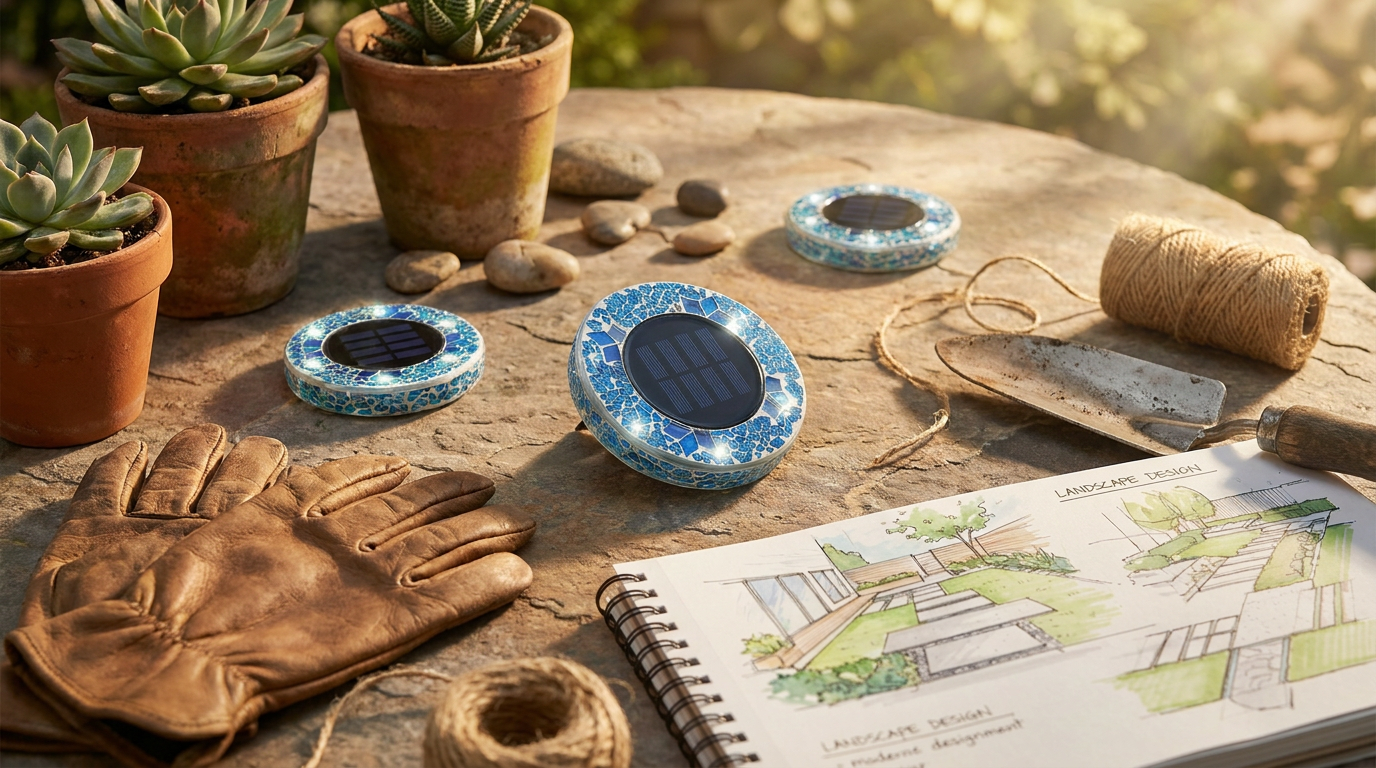
Integrating Solar Mosaic Disk Lights into Modern Landscaping
 Sam VasquezBuying Guide Lead
July 10, 2026. This guide explores the intersection of decorative glass artistry and renewable energy for residential outdoor spaces. It is written for homeowners who need reliable ground-level illumination without the complexity of wired electrical systems.
The Challenge of Low-Profile Outdoor Lighting
Standard garden stakes often present a physical hazard in high-traffic areas or spaces where children and pets play. Traditional path lights stand several inches off the ground, making them prone to being knocked over by lawnmowers or foot traffic. Furthermore, many entry-level solar lights lack the aesthetic character required for a curated landscape. Homeowners frequently find themselves choosing between industrial-looking plastic stakes and expensive, hard-wired architectural lighting. According to Bell + Howell, the demand for waterproof, decorative pathway LED lights has increased as more residents look for auto-on/off solutions that don't require manual switching or timers. The difficulty lies in finding a fixture that sits flush or near-flush with the ground while still providing enough lumens to be functional. Standard disk lights often look like simple metal pucks, which can feel sterile in a garden beds or near stone walkways. This is where the texture of mosaic glass becomes a functional asset rather than just a visual one, as the glass fragments help diffuse light horizontally across the ground surface rather than just projecting it straight up.
Performance and Durability of Mosaic Systems

Photo by Mehmet Kaya on Pexels
When evaluating Solar Mosaic Disk Lights, the technical specifications reveal why they outperform standard plastic alternatives. These units typically feature six super-bright LEDs housed within a water-resistant, mosaic stone-style casing. The construction is designed to withstand diverse weather conditions, which is a significant upgrade over the thin-walled plastic stakes found at big-box retailers. Between the standard flat models and the mosaic versions, I’d go with the mosaic every time because the solar flat garden lights mosaic glass options provide a textured light pattern that masks the harsh glare of raw LEDs. The internal rechargeable batteries are powered by integrated solar panels that sit flush with the glass, ensuring that the charging process is unobtrusive. In my experience, the blue mosaic variants are particularly effective for properties with water features or cool-toned stonework. If you are looking for a way to define boundaries, using solar mosaic disk lights along the edge of a gravel path provides a distinct visual guide that remains visible even in light snow or heavy rain. The durability factor is reinforced by the fact that these are frequently sold in multi-packs, such as those found at Tractor Supply, which highlights their role as a utility-focused lighting solution for large-scale perimeter work. Unlike vertical stakes, these disk lights can be placed directly into the soil or even on flat surfaces like decks and stairs, provided they receive direct sunlight during the daylight hours.
Selection and Placement Strategy
Choosing the right lighting requires a look at your specific terrain and the amount of daily sun exposure your yard receives. Skip this if your garden is under a permanent heavy canopy of trees; these units need direct UV exposure to hit the internal sensors. If you're on a budget, you might be tempted to buy the cheapest bulk pack of plastic stakes, but the replacement cycle on those usually makes them more expensive within two seasons. Here's what I'd actually buy: a set of the solar flat garden lights mosaic glass for the main entrance path and the standard solar mosaic disk lights for the secondary garden borders. This creates a cohesive look without overwhelming the space with too many competing textures. When you are ready to install, follow this checklist to ensure longevity:
- Verify the site receives at least 6 hours of unshaded sunlight.
- Clear the ground of large rocks or roots before pressing the stakes into the soil.
- Clean the mosaic glass surface once a month with a damp cloth to maintain charging efficiency.
- Position the lights approximately 3 to 5 feet apart for a continuous glow.
- Check the waterproof seals after the first major storm of the season.
- Ensure the power switch on the underside is set to 'On' before the initial charge.
Shop Solar Mosaic Disk Lights here
Sources
Photo by Nothing Ahead on Pexels
- Solar Disk Lights - Bell + Howell
- Bell & Howell Blue Mosaic Solar Disk Lights
- Bell & Howell Mosaic Disk Lights Blue Solar Powered LED ...)