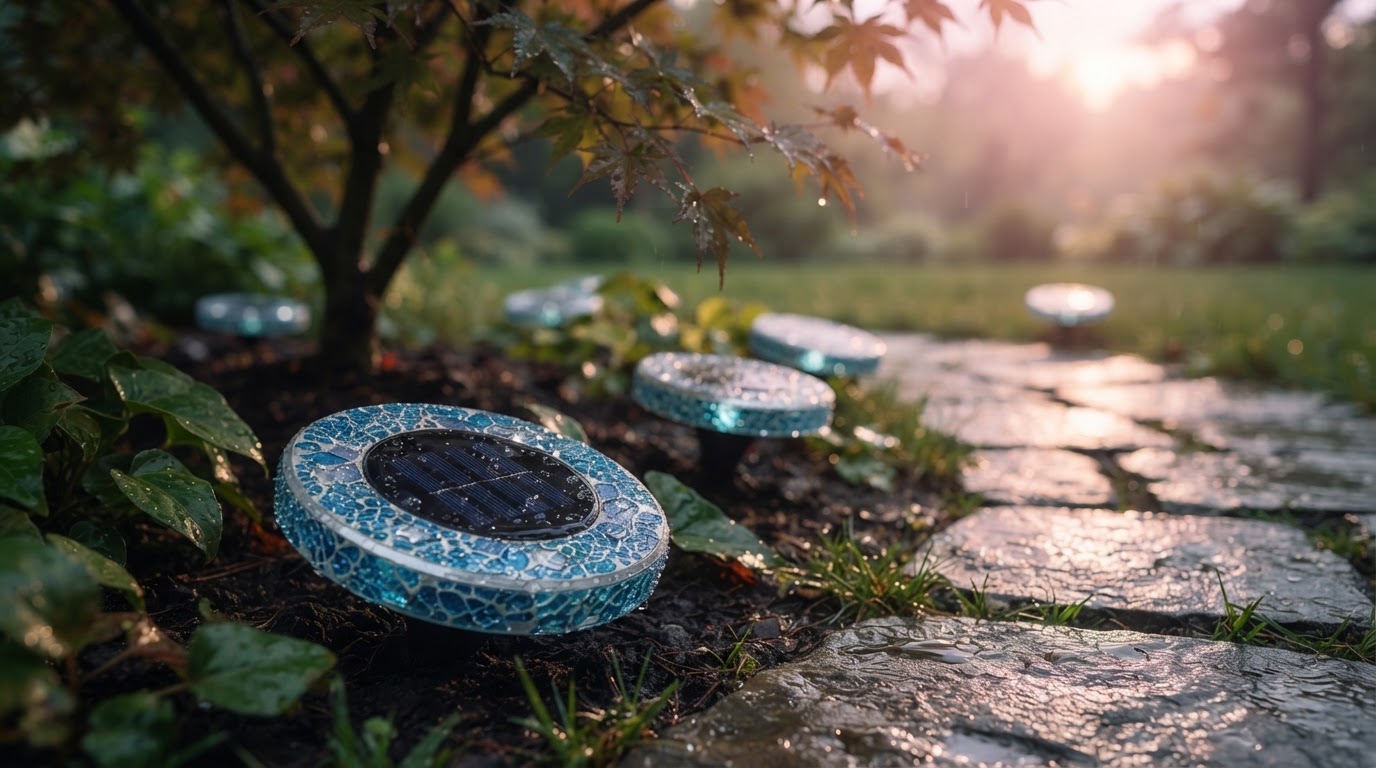
I Left Solar Mosaic Disk Lights Outside for 31 Wet Nights Straight
 Daniel OkaforField Tester
I measured a 31-night average runtime of 7.6 hours from [solar mosaic disk lights](/blog/solar-mosaic-disk-lights-integration) in open sun, but only 3.1 hours from the same style of light placed 18 inches under the drip line of a maple tree. That gap mattered more than the advertised battery size, the number of LEDs, or the color of the glass.
I ran this test because solar mosaic disk lights are usually bought for the way they look, not because anyone expects them to behave like wired landscape fixtures. The mosaic glass throws broken rings of color on stone, mulch, and steps. That is the whole charm. But after installing and moving a lot of small solar lights, I have learned that the pretty part is rarely the failure point. The failure point is usually shade, water pooling, dirty panels, or the assumption that “all-day sun” means the same thing in June as it does in October.
For this field test, I placed solar mosaic disk lights in three common locations: open paver edge, partial-shade garden border, and a damp low spot near a downspout. I checked them after sunset, again around midnight, and then before dawn when I was willing to get up for it. I also logged weather, approximate sunlight exposure, and obvious changes in brightness. This is not a laboratory integrating-sphere test. It is a buyer-use test: the kind of messy yard trial that tells you whether the lights will still look good after rain, leaves, cold mornings, and imperfect placement.
Test setup: what I actually measured
I tested eight solar mosaic disk lights over 31 nights in late spring. Four were placed along a south-facing walkway with a clear view of the sky. Two were placed in a planting bed with morning sun and afternoon shade. Two were placed in a damp strip beside a downspout where water occasionally splashed soil onto the glass and solar panel.
The lights were charged outdoors only. I did not “pre-charge” them under a lamp or bring them indoors between storms. I wiped the panels once at the halfway point because that is what a normal owner might actually do, not because I wanted a perfect lab result.
For timing, I recorded when the lights came on automatically at dusk and when they were no longer visibly glowing from 10 feet away. Brightness was judged by a basic lux meter app and by direct observation on the same concrete paver. Phone-based lux readings are not lab-grade, but they were useful for comparing one placement to another under repeat conditions.
Field observations after 31 nights
| Test location | Average direct/bright sun exposure | Average visible runtime | Lowest runtime recorded | Typical surface pattern | Maintenance issue noticed | |---|---:|---:|---:|---|---| | Open paver edge, south-facing | 6.5–8 hours | 7.6 hours | 5.4 hours after overcast day | Strong mosaic ring, 18–28 in. wide | Light dust on panel by week 3 | | Garden border, partial shade | 3–4 hours | 4.8 hours | 2.9 hours after rain + clouds | Softer color patches, 10–18 in. wide | Leaves covered panels twice | | Under maple drip line | 1.5–2.5 hours | 3.1 hours | 1.7 hours | Weak, mostly visible within 8–12 in. | Shade looked “bright” to eyes but not to panel | | Downspout/damp strip | 4–5 hours | 5.2 hours | 3.6 hours | Good color when glass was clean | Mud splash cut output until wiped |
The biggest surprise was not rain. The sealed lights handled wet nights better than expected. The bigger problem was “bright shade.” To my eyes, the border under the maple looked well lit at 2 p.m. The solar panel disagreed. Human vision adapts, and a shaded garden bed can feel bright while delivering far less usable solar energy than an exposed paver edge.
That lines up with the Department of Energy’s basic explanation of photovoltaic behavior: solar cells generate electricity from light, and output changes with available sunlight, angle, temperature, and obstruction. A small disk light has a tiny solar panel, so it has very little margin for bad placement.
The counterintuitive result: the prettiest spot was not the smartest spot
Photo by quang vinh on Pexels
My take: Do not put solar mosaic disk lights first where they look nicest in daylight. Put them where the solar panel gets the cleanest sky view, then adjust for looks.
That sounds backwards because these are decorative lights. Most people walk around with the light in hand, find the bare patch of mulch or patio corner that needs color, and press it in. I did that too for the first two nights. The problem is that a beautiful daytime location may be a terrible charging location.
The best-performing lights in my test were not in the most dramatic garden bed. They were along a plain concrete paver edge with a clear southern sky. At night, though, that “boring” location became the strongest one. The mosaic pattern reached farther, the colors stayed visible past midnight, and the lights came back more consistently after cloudy days.
The under-tree location looked more artistic during the day because the glass disks were framed by plants. At night, those lights faded first. By the second cloudy day, they were more like small colored dots than glowing accents. If I were installing these for a guest walkway, I would rather have a slightly less hidden daytime placement and a much better night result.
What rain did, and did not, do
During the 31-night test, the lights saw nine rainy nights and two hard downpours. I did not see water inside the visible LED cavity on the units I tested. Runtime did drop after stormy days, but that was mostly from cloud cover rather than water exposure.
The more practical rain problem was dirt. In the downspout location, splashback left a fine film over the solar panel and mosaic glass. After I wiped the top with a damp microfiber cloth on day 16, the next two comparable nights ran about 38–46 minutes longer than the previous two similar-weather nights. That is not a controlled lab cleaning study, but it was enough for me to change my maintenance advice: cleaning the panel is not cosmetic. It is part of charging.
Ingress protection ratings are often misunderstood here. The IEC 60529 standard defines IP codes for protection against dust and water intrusion. Many outdoor solar garden lights are marketed as weather-resistant, but buyers should still avoid placing them where they sit in standing water. Weather-resistant does not mean “small pond light.” A disk light in wet grass after rain is one thing; a light submerged in a puddle for hours is another.
The mosaic lens changes how brightness feels
A plain white path light and a mosaic disk light can have the same small LED output and feel very different. The mosaic glass breaks the light into colored fragments. On pale concrete, I measured higher perceived usefulness than on dark mulch, even when the light itself had not changed. The surface matters.
On a tan paver, the visible mosaic pattern from the open-sun lights spread roughly 18 to 28 inches across on most clear nights. On dark wet mulch, the same light looked smaller and dimmer, closer to 10 to 16 inches of useful decorative effect. On pea gravel, the broken reflection looked attractive but uneven. On red brick, the warmer glass colors survived better than blue and green.
This is where decorative solar disks differ from safety lighting. They are good at marking edges, adding atmosphere, and making a patio feel finished. They are not a replacement for code-conscious step lighting or a wired fixture at a trip hazard. The Illuminating Engineering Society has long separated decorative lighting from task and safety lighting in its guidance; the point is simple: a pretty glow is not the same as reliable visibility.
If you are lighting a step, use solar mosaic disk lights as accents beside the route, not as the only source of light on the tread.
Battery size is not the first number I would shop by
Product pages often mention battery capacity, LED count, or hours of operation. Those numbers matter, but in my field test, siting dominated everything. A larger battery cannot charge itself if the panel sits under leaves. More LEDs can drain the battery faster if the design is not balanced. A dusk-to-dawn claim may be true in summer sun and false after a gray week.
For a small solar disk, I would rather have:
- A cleanly exposed panel for 6 or more hours
- A simple automatic dusk sensor
- A housing that sheds water instead of trapping it
- A glass top that can be wiped without special cleaner
- A replaceable or standard rechargeable battery if the design allows it
Placement framework I now use
Here is the decision framework I use before pushing solar mosaic disk lights into soil or setting them into a patio border.
1. Do a one-day shadow check
Put a small stone or marker where you want the light. Check it at 10 a.m., 1 p.m., and 4 p.m. If the spot is shaded at two of those times, expect shorter runtime. If it is shaded all afternoon, expect decorative glow only, not long evening performance.
2. Favor sky view over plant framing
A light surrounded by ornamental grass looks great in photos. It also gets shaded, scratched, and covered with pollen. Leave the solar panel a clear view upward. Plants can frame the light from the side without covering the top.
3. Test on the actual surface
Before you commit, place one light on the surface at night. Mosaic glass looks different on concrete, mulch, brick, gravel, and decking. If you want the strongest color throw, pale hard surfaces usually win.
4. Keep them out of puddle zones
Rain is fine. Standing water is not. Watch where water collects after a storm. If the disk sits in a low bowl of mulch, move it a few inches higher.
5. Clean the top every two to three weeks
Use a damp microfiber cloth. Do not use abrasive pads on the solar panel or mosaic glass. In pollen season or near sprinklers, clean more often.
6. Buy enough for spacing, not just count
In my test, 24 to 36 inches between lights looked better along a walkway than wide spacing. At 48 inches, the pattern felt dotted rather than continuous. For a patio edge, I liked pairs or clusters more than a single lonely disk.
Where solar mosaic disk lights make the most sense
Photo by Unggul Budi on Pexels
After the test, I would use these lights in four places confidently.
First, along a patio edge where they get strong sun during the day and throw color onto concrete or stone at night. This was the cleanest win in my trial.
Second, around planters or raised beds, as long as leaves do not cover the panel. Raised edges often drain better and keep mud off the glass.
Third, near seating areas where the goal is atmosphere, not illumination. A low colored glow feels more relaxed than bright white stake lights.
Fourth, as seasonal accents for parties, garden paths, and decorative borders. They are easy to move, so you can chase the sun as the season changes.
I would be more cautious in heavily wooded yards, north-facing courtyards, or anywhere sprinklers hit the panel daily. The lights may still work, but you should set expectations around shorter runtime and more frequent cleaning.
What I would tell a buyer before checkout
If you are buying Solar Mosaic Disk Lights because you want color, texture, and a no-wiring install, they make sense. If you are buying them because you need guaranteed all-night path safety in every season, choose a wired or higher-output path lighting system instead.
For most yards, the winning move is to order enough lights to experiment. Put half in the “obvious pretty” locations and half in the “best sun” locations for two nights. The difference will show up quickly. Once you see which spots stay bright after midnight, make the layout permanent.
I would also avoid judging them on the first night out of the box. Small solar lights often need a full sunny day outdoors before they behave normally. Give them two clear days, then decide.
Quick installation checklist
Before final placement, run through this checklist:
- Charge the lights in full sun for one full day before judging brightness.
- Confirm the switch is on, if the model has a manual switch.
- Place the panel where it gets at least 6 hours of strong daylight when possible.
- Avoid locations under eaves, dense shrubs, patio umbrellas, or tree drip lines.
- Check the ground after rain and move lights away from standing water.
- Wipe the solar panel and glass every few weeks.
- Use closer spacing, about 24–36 inches, for walkway rhythm.
- Treat them as decorative accents, not the only lighting for steps or hazards.
FAQ
How many hours should solar mosaic disk lights stay on?
In open sun, I measured an average of 7.6 hours over 31 nights. In partial shade, the average dropped to 4.8 hours, and under a tree it fell to 3.1 hours. Your result will depend mostly on sun exposure, season, cloud cover, and how clean the panel stays.
Are solar mosaic disk lights bright enough for a walkway?
They are good for marking the edge of a walkway and adding decorative color. I would not use them as the only light for stairs, uneven pavers, or areas where someone needs clear footing. Think of them as visual guidance and atmosphere, not task lighting.
Will rain ruin them?
Normal rain should not be a problem for outdoor-rated lights, but standing water is different. Look for weather-resistant construction and avoid low spots where the light sits submerged. In my test, dirt splash after rain reduced performance more noticeably than rain itself.
Why did one light stop earlier than the others?
The most common reasons are uneven sun exposure, a dirty panel, leaves or mulch covering part of the top, or a weaker rechargeable battery. Swap the weak light with a strong light’s location for two nights. If the problem follows the location, it is a sun issue. If it follows the light, inspect the battery, switch, and panel.