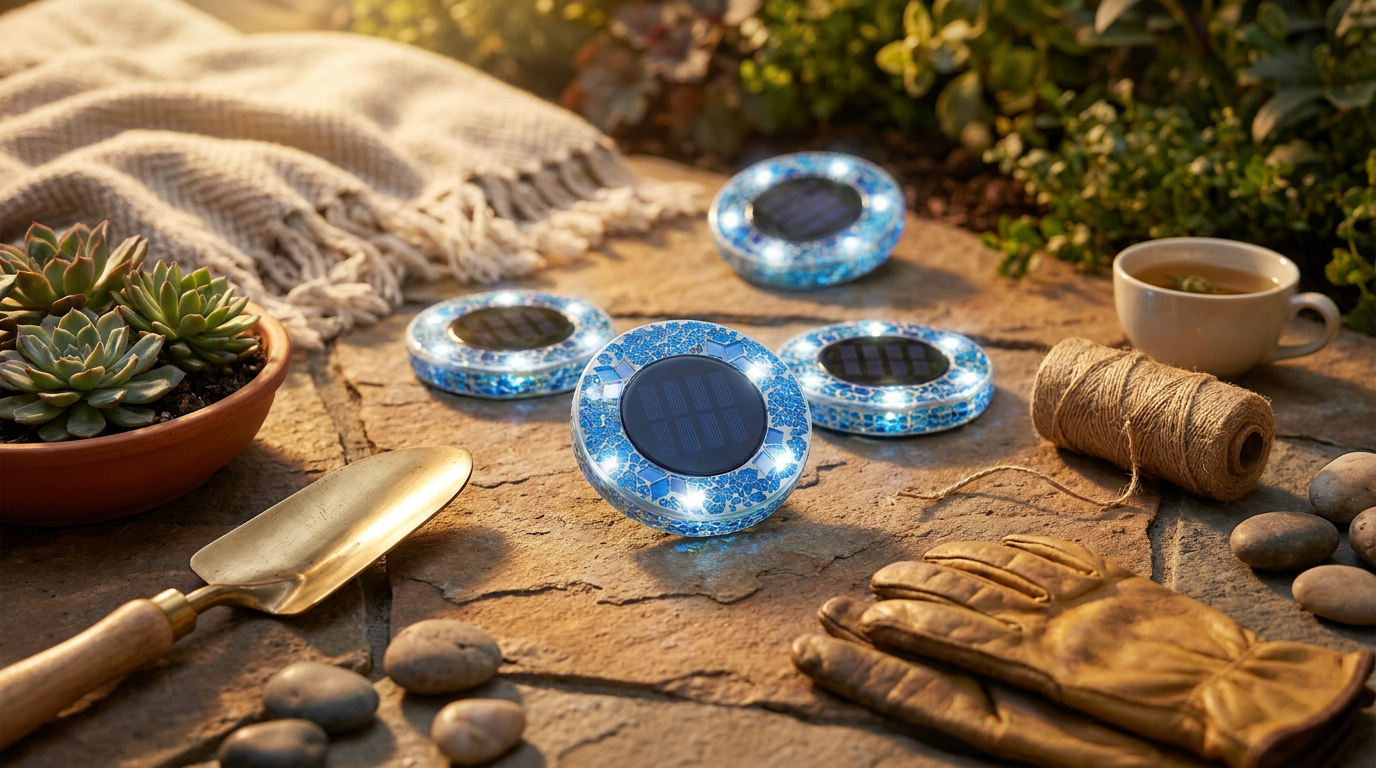
Enhancing Lawn Aesthetics with Solar Mosaic Disk Lights
 Jordan HaleStaff Writer
June 20, 2026. This exploration details the integration of flat-profile mosaic lighting into modern residential landscapes for homeowners seeking a balance of durability and visual texture.
The first thing I noticed was the weight of the glass against the palm of my hand—a cool, substantial density that felt more like an artisanal paperweight than a standard garden utility. Walking across my lawn at dusk, the grass still holding the day's heat, I realized how much traditional stake lights disrupt the visual flow of a flat green space. They stand like plastic sentinels, often leaning at awkward angles after a heavy rain or a run-in with the lawnmower. According to Mosaic Solar Lights - eBay, these decorative mosaic glass pathway lights are designed to offer a colorful LED glow that sits closer to the earth, creating a pool of light rather than a harsh beam. The problem with most lawn lighting isn't just the lack of durability; it is the lack of character. Most options are utilitarian black plastic that disappears into the shadows by day and looks like a landing strip by night. Transitioning to a flat-profile system allows the grass to remain the focal point while the mosaic patterns provide a secondary layer of interest. When you integrate mosaic flat solar lights for lawn into a manicured space, you are solving the spatial clutter problem common in smaller suburban yards. It turns out that the height of a light fixture is often its greatest weakness in a high-traffic family yard where dogs and children roam freely. By choosing a disk-based geometry, the light source is protected by its proximity to the ground, allowing it to blend into the turf during the day while providing a stained-glass effect once the sun dips below the horizon.
Solar Mosaic Disk Lights address the specific environmental challenges of the open lawn by utilizing a low-profile housing that resists the typical wear and tear of outdoor maintenance. Somewhere around week two, I watched the neighbor’s mower pass within inches of the disk perimeter, and the light remained undisturbed. This resilience is a byproduct of the flat design, which allows the units to be recessed or placed flush against the soil. Unlike decorative solar pathway disks that might be used to define a hard edge, these mosaic variants are intended to be scattered or clustered within the green space itself. The light is filtered through hand-placed glass fragments, which breaks up the typical sterile white glare of a standard LED. This creates a dappled effect on the blades of grass, mimicking the way moonlight filters through tree canopies. Because the charging panel is integrated directly into the center of the mosaic pattern, the unit maintains a seamless look without the bulky external solar cells found on cheaper models. This integration is crucial for maintaining the aesthetic integrity of mosaic flat solar lights for lawn across a wide expanse. I keep coming back to the way the colors shift depending on the angle of approach; a deep cobalt from one side might transition into a warm amber as you walk past. This kinetic quality makes the lawn feel like a living gallery. For those who have already experimented with decorative solar pathway disks, adding the mosaic texture provides a necessary contrast to the solid metallic finishes often found in high-end landscape kits. The internal battery capacity is optimized for 6 to 8 hours of illumination, ensuring that the visual interest persists well into the evening hours without the need for trenching or complex wiring that typically plagues ground-level installations.
Choosing the right placement for these fixtures requires a framework that considers both solar exposure and the physical layout of the yard. It is not enough to simply drop them into the grass; they perform best when the soil is slightly aerated to allow the base to sit level. When evaluating your space for mosaic flat solar lights for lawn, consider the following criteria to ensure longevity and performance:
- Direct Sunlight Access: Ensure the chosen spot receives at least six hours of unshaded light to fully charge the internal cells.
- Mowing Clearance: Measure the height of your mower blades to ensure the disk profile sits safely below the cutting path.
- Soil Drainage: Avoid placing disks in low-lying areas where water pools, as consistent submersion can eventually degrade the seals.
- Visual Rhythm: Space the units roughly three to five feet apart to create a continuous wash of light rather than isolated spots.
- Color Harmony: Match the mosaic glass tones to your existing floral palette or home exterior accents for a cohesive look.
Shop Solar Mosaic Disk Lights here
Sources