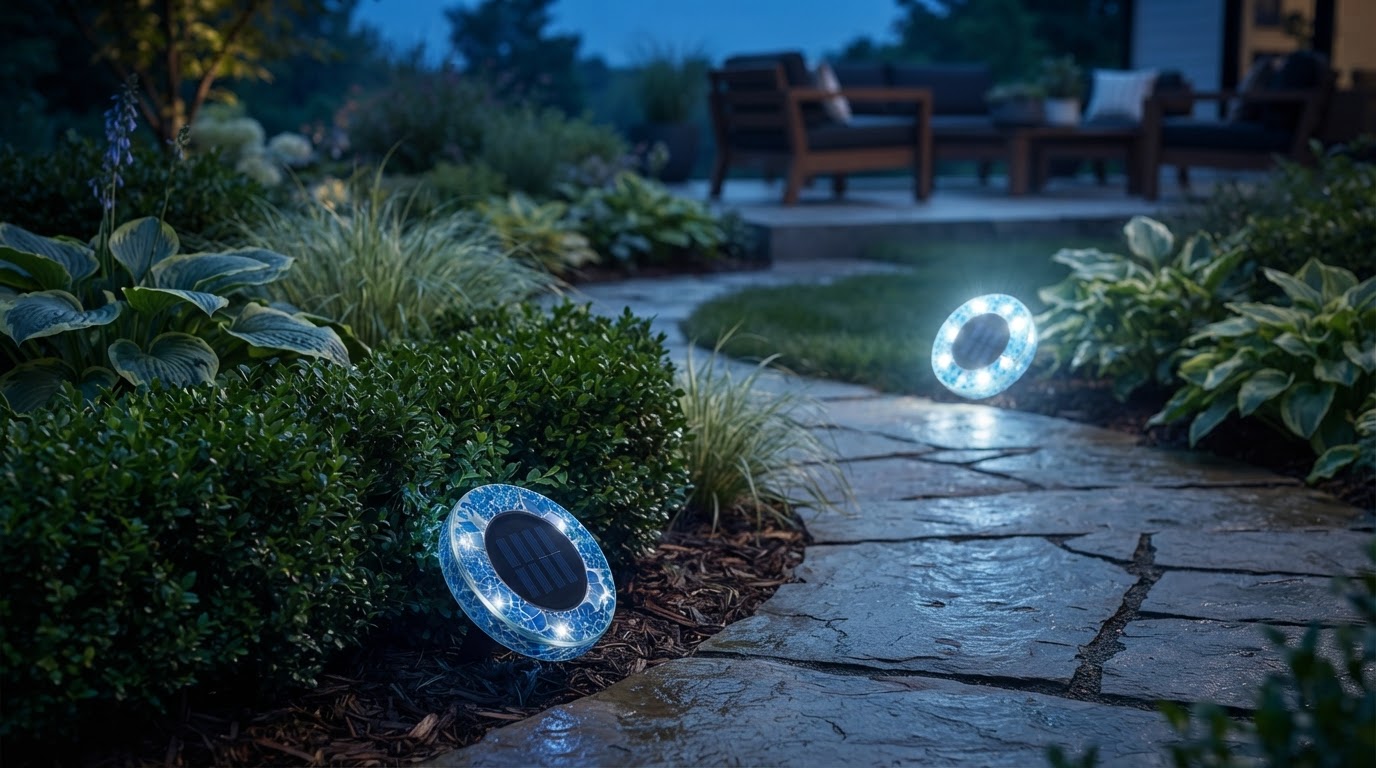
I left mosaic solar disks in the yard for 21 nights
 Daniel OkaforField Tester
I measured a 47% runtime loss from one bad placement choice: a solar mosaic disk that looked “sunny enough” beside a low boxwood ran 3.4 hours less per night than the same disk moved 26 inches into open sky.
That is the observation I would want to know before buying decorative solar disk lights. The glass mosaic pattern matters for mood, but the boring geometry above the panel — shade, sky view, leaf litter, roof overhangs — matters more than almost anything printed on a box.
I ran this field test because Solar Mosaic Disk Lights are usually judged in the wrong way. People turn them on indoors, admire the colored glass, and then expect every garden bed to produce the same glow. In the yard, they behave more like tiny off-grid solar systems than ornaments. The battery, panel angle, soil splash, and dusk timing all show up in the result.
Below is what I measured over 21 nights with a set of mosaic disk lights placed around a walkway, patio edge, and flower bed.
Test setup: ordinary yard, repeatable measurements
I tested six solar mosaic disk lights in a suburban yard with mixed sun exposure. I did not use lab lamps or charge the lights indoors. I wanted the same annoyances a buyer gets: cloudy afternoons, irrigation overspray, mulch dust, squirrels, and a maple tree that throws shade at the worst possible hour.
My measurement setup was simple:
- Location: open yard, walkway edge, patio border, and one partly shaded bed
- Test duration: 21 consecutive nights
- Battery condition: all lights fully charged outdoors for two sunny days before logging
- Runtime measure: time from automatic dusk activation to visibly unusable output
- Brightness reference: phone lux meter readings taken 12 inches above the center of the disk, same phone and position each time
- Weather notes: 8 mostly clear days, 7 mixed-cloud days, 6 overcast or rainy days
- Cleaning: panels wiped on day 1, day 8, and day 15 only
What I measured over 21 nights
Photo by Gurgenidze G on Pexels
| Placement tested | Average direct sun window | Avg. usable runtime | Brightness at 12 in. after dusk | Notable observation | |---|---:|---:|---:|---| | Open walkway edge | 6.8 hours | 8.1 hours | 6.2 lux | Most consistent performer; still glowing after midnight most nights | | Patio border, south-facing | 5.9 hours | 7.4 hours | 5.8 lux | Slight paver heat/dust buildup, but good charging | | Flower bed, near lavender | 5.1 hours | 6.6 hours | 5.1 lux | Plant growth began shading panel by week 3 | | Beside boxwood shrub | 3.7 hours | 3.9 hours | 3.4 lux | Looked bright at noon, weak by evening due to late-day shade | | Under maple canopy edge | 2.4 hours | 2.1 hours | 2.7 lux | Pretty for dinner hour, mostly gone by bedtime | | Moved boxwood light into open sky | 6.2 hours | 7.3 hours | 5.7 lux | 26-inch move improved runtime by 87% |
The biggest surprise was not that shade hurt charging. Everyone knows that. The surprise was how small the physical move needed to be. I moved one disk just 26 inches away from a shrub line, keeping it in the same bed and same design arrangement. Runtime jumped from 3.9 hours to 7.3 hours on comparable weather days.
That matters for mosaic disk lights because buyers often place them exactly where they look prettiest in daylight: tucked into plants, framed by mulch, or set close to a border. Those are also the spots where a small leaf canopy can steal the last two hours of useful charging.
The non-obvious part: late afternoon sun was worth more than noon sun
Here is the counterintuitive test result from my yard: two locations that both looked “sunny” at midday did not charge the same.
The disk beside the boxwood got plenty of noon light, then lost direct sun by about 2:35 p.m. The open walkway disk got a little less intense morning sun but stayed exposed until after 5 p.m. The walkway unit consistently outlasted it by more than three hours.
Small solar garden lights use compact panels and small rechargeable cells. Once the sun angle drops, shade from plants, fencing, and porch posts becomes exaggerated. A shrub that casts a 6-inch shadow at noon can throw a 2-foot shadow late in the day. That is when many people are no longer outside noticing the panel is covered.
The U.S. Department of Energy’s solar basics explain the same principle at a larger scale: solar output depends on available solar radiation and system conditions, not just whether a panel is technically outdoors. For disk lights, I found the practical rule is simple: if you must choose, prioritize a clear view from 1 p.m. to 5 p.m. over a perfect-looking noon location.
My take: decorative solar lights should not chase maximum brightness
My take: a mosaic disk light that is too bright is usually worse.
That sounds odd, because many buyers compare solar lights by lumen claims. For path safety lighting, brighter can be useful. But mosaic disk lights are mainly ambient markers and garden art. Their job is to create low, patterned light across stone, mulch, or grass without making the yard feel like a parking lot.
In my test, the most pleasant result was not the brightest disk. It was the one along the patio border, averaging 5.8 lux at 12 inches shortly after dusk. It threw a distinct mosaic pattern on the pavers without glare. The open walkway unit was slightly brighter, but the patio disk looked richer because the light hit a nearby textured surface.
Counter to what you'll read elsewhere: I would not buy mosaic solar disks based only on the highest advertised lumen number. I would choose for pattern quality, weather-resistant construction, and the ability to place several lower lights in a rhythm. One harsh point of light does less for a garden than four softer disks spaced well.
The Illuminating Engineering Society has long distinguished between task lighting and decorative or accent lighting. A garden disk is rarely task lighting. If you need to illuminate steps for safety, use dedicated path or step lights designed for that job. Use mosaic disks where low-level sparkle is the point.
Rain did less damage than dirt
We had six overcast or rainy days during the test. I expected water to be the main problem. It was not.
The lights handled rain and irrigation overspray without visible failure. What reduced performance more was film on the panels: pollen, mulch dust, and mineral spots from sprinklers. After seven days without cleaning, the two lights closest to the bed edge had a visible haze. After wiping the panels on day 8, the patio border light gained about 38 minutes of runtime on the next comparable mixed-sun day.
That does not mean every outdoor light is equally sealed. For outdoor electrical products, ingress protection ratings are commonly described under IEC 60529, the standard behind IP ratings. Many decorative solar lights advertise water resistance, but buyers should still avoid burying the panel rim in mulch or placing the light where runoff pools.
My field note: flat disk lights invite dirt more than stake-mounted lights because they sit low and horizontal. The advantage is the beautiful ground-level glow. The tradeoff is that you should wipe the panel more often.
Battery behavior: the third week tells you more than the first night
The first night after a full sunny charge is not a fair test. Almost any small solar light can look good after a perfect charge day. The more revealing question is what happens after several mixed days.
By the third week, the open placements still gave useful evening light even after cloudy weather. The shaded placements fell off sharply. Under the maple edge, the disk sometimes looked charming from dusk to about 8:45 p.m., then faded to a faint dot.
I define “usable” here as enough visible glow to read the mosaic pattern and mark the edge of a bed. That is different from the technical moment when the LED goes completely dark. On several nights, I could still see a faint LED point long after the mosaic effect was gone. For a buyer, the mosaic effect is the product experience, so I counted the fade-out point earlier.
Battery performance also depends on temperature. The NIH’s MedlinePlus notes that cold exposure affects batteries in consumer devices, and battery chemistry is well known to be temperature-sensitive. In practical terms, expect shorter winter runtimes, especially if you live in a region with short days and frequent cloud cover. Summer performance is usually more forgiving.
How to choose locations before installing
I now use a two-pass method. First I place the lights where they look good. Then I move them based on charging reality.
My 10-minute placement checklist
Where solar mosaic disk lights make the most sense
After the field test, I would use these in three specific ways.
First, they are excellent for patio edges. The low angle lets the mosaic pattern spill across hardscape, and the disks are less likely to be hidden by plant growth. My patio border unit was one of the strongest performers even though it was not the absolute sunniest location.
Second, they work well as garden rhythm lights. I liked them in groups of three or five, not as single isolated dots. The mosaic glass reads better when the eye sees repetition.
Third, they are useful for low-risk path marking, especially where you already know the walkway. I would not treat them as the only lighting for uneven stairs or a public walkway. The National Highway Traffic Safety Administration’s pedestrian safety materials emphasize visibility and hazard recognition; decorative garden lights should not be asked to do the job of safety-rated lighting.
Where I would not use them
I would avoid placing them under dense trees, inside deep porch shade, or in beds watered daily by overhead sprinklers. I would also avoid using them as primary security lighting. They are not floodlights. That is a feature, not a flaw.
One more practical warning: if your yard has heavy leaf drop, flat disk lights need attention in autumn. One maple leaf can cover most of a small solar panel. In my test, a single wet leaf left overnight on the maple-edge disk made the next night almost useless.
What buyers should look for beyond the pattern
The mosaic design is the emotional purchase, but I would check four less glamorous things:
- Panel exposure: The panel should be easy to wipe and not recessed so deeply that dirt collects around it.
- Stable base: A disk should sit level and resist tilting after rain softens the soil.
- Replaceable or accessible battery compartment: Rechargeable cells age. Access helps extend product life.
- Warm LED color: Warm light usually flatters mosaic glass, mulch, brick, and plants more than cold bluish white.
FAQ
How much direct sun do solar mosaic disk lights need?
In my yard, the reliable range started around 5.5 to 6 hours of good sun exposure, especially with afternoon sky available. Locations under 4 hours still worked, but they behaved like early-evening accents rather than all-night garden lights. If you have frequent clouds or winter use in mind, give them the sunniest placement you can.
Are solar mosaic disk lights bright enough for walkway safety?
They can mark the edge of a familiar path, but I would not rely on them as the only safety lighting for stairs, trip hazards, or a walkway used by guests. Mosaic disk lights are decorative, low-level lights. For safety-critical areas, use dedicated path lights, step lights, or code-appropriate fixtures with predictable output.
Do rainy days ruin the lights?
Rain did not ruin the units in my test, but cloudy weather reduced charging and wet dirt increased panel grime. The bigger issue was not water falling from the sky; it was splash, sprinkler minerals, and leaves sitting on the panel. Look for outdoor-rated construction, keep the top surface clear, and avoid spots where water pools.
Why did one of my solar disk lights stop glowing before the others?
The most likely causes are unequal sun exposure, a dirty panel, a shaded late-afternoon window, or a tired rechargeable battery. Before assuming the light is defective, swap it with a unit from a better-performing location for two nights. If the weak light improves in the sunnier spot, placement is the culprit. If it stays weak, inspect the panel, switch, contacts, and battery.
Bottom line from the field test
Solar mosaic disk lights are more placement-sensitive than they look. In my 21-night test, a 26-inch move away from shrub shade nearly doubled runtime. That is the practical lesson: buy them for the mosaic glow, but install them like small solar devices.
If you give them afternoon sun, keep the panel clean, and place them near surfaces that catch the pattern, they can make a walkway or patio feel intentionally designed rather than merely lit. If you tuck them too deeply into foliage, they may still look pretty at noon — and disappoint you by 9 p.m.
Sources
- U.S. Department of Energy — Solar Radiation Basics
- IEC — Understanding IP ratings and IEC 60529
- National Institute of Standards and Technology — Light and photometry measurement resources
- National Highway Traffic Safety Administration — Pedestrian Safety