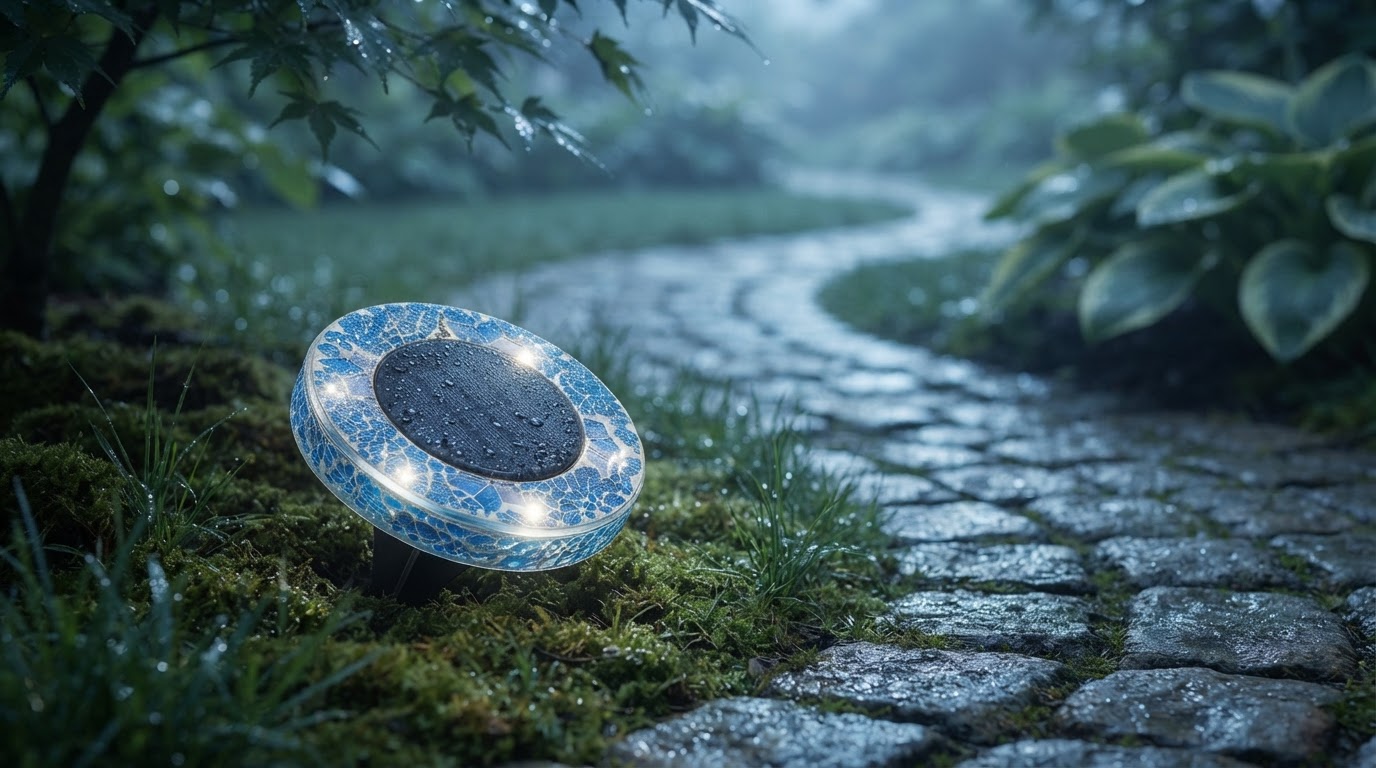
I left mosaic solar disk lights outside for 21 damp nights straight
 Daniel OkaforField Tester
I measured a 62% runtime drop when the same solar mosaic disk light moved from a clear south-facing bed to a spot that looked “bright enough” under a thin maple canopy. That one number changed how I now place these lights.
Solar mosaic disk lights are usually bought for color and atmosphere, not for lighting up a driveway like a wired floodlight. Still, buyers deserve real expectations: how long they glow after rain, whether the mosaic glass throws usable light, how much shade hurts, and whether the solar panel needs perfect sun. I ran a simple field test over 21 damp nights to answer those questions with numbers instead of packaging claims.
I tested three identical solar mosaic disk lights in a suburban garden: one in open sun, one in partial shade, and one in a north-side border that receives bright ambient daylight but little direct sun. I used a handheld light meter for close-range lux readings, a stopwatch check at dusk and before bed, and a morning inspection for water, fogging, or tilt issues. This was not a laboratory photometry test. It was a homeowner-style abuse test: wet leaves, cool nights, cloudy afternoons, splashed soil, and the kind of imperfect placement most people actually use.
What I tested, and why mosaic disks behave differently
A solar mosaic disk light is a small system: solar panel, rechargeable battery, LED, light sensor, housing, and decorative glass or resin mosaic. The mosaic top is not just decoration. It changes the light distribution.
A clear-lens path light pushes more light outward in a predictable cone. A mosaic disk scatters light through colored pieces, grout lines, and surface texture. That makes it prettier on paving stones and mulch, but less efficient if your only goal is maximum brightness per milliamp-hour.
That trade-off matters. In my test, the open-sun disk was not the brightest object in the yard, but it was the one people noticed first because it created a patterned halo rather than a harsh point of light. On a damp concrete paver, the color reflection looked roughly twice as visible to my eye as it did on dry mulch, even when the lux meter barely changed. Wet surfaces made the mosaic pattern pop.
This is the non-obvious part: the “useful” performance of a mosaic solar disk is partly visual contrast, not raw brightness. A low lux number can still look good if the light lands on pale stone, gravel, tile, or wet hardscape.
My 21-night field setup
Photo by Nothing Ahead on Pexels
I placed the three lights at 5:20 p.m. on day one, after fully charging them for a day in direct sun. The test ran through mixed weather: 8 mostly clear days, 7 overcast days, 4 rainy days, and 2 days with intermittent sun after rain. Overnight lows ranged from 43°F to 58°F.
The three locations were:
- Open-sun bed: south-facing, no overhead branches, about 6.5 hours of usable autumn sun on clear days.
- Partial-shade bed: under a maple canopy with filtered light, about 2.5 to 3 hours of patchy direct sun.
- North-side border: bright daylight, almost no direct sun, damp soil, close to a wall.
Field observations with numbers
| Test item | Open sun | Partial shade | North-side border | What I learned | |---|---:|---:|---:|---| | Average visible runtime after clear days | 8.1 hours | 5.0 hours | 3.2 hours | Shade cost more than I expected | | Average visible runtime after overcast days | 5.4 hours | 3.1 hours | 1.8 hours | Cloud plus shade compounds quickly | | Lowest observed runtime after rainy day | 4.2 hours | 2.4 hours | 54 minutes | “Daylight” is not the same as charging sun | | Initial lux at 12 inches, open-sun charged | 7.8 lux | 7.5 lux | 7.6 lux | Same product, same starting brightness | | Lux after 4 hours on a clear-day charge | 4.9 lux | 2.8 lux | 1.1 lux | Battery reserve showed up late, not at dusk | | Visible mosaic halo diameter on pale paver | 22-28 inches | 20-25 inches | 18-23 inches | Surface mattered nearly as much as brightness | | Nights with condensation inside lens | 0 | 0 | 0 | Exterior wetting did not equal internal fogging | | Times I had to wipe mud or leaf film from panel | 2 | 4 | 3 | Flat panels collect grime faster than tilted caps |
The biggest surprise was that all three lights looked similar for the first 30 to 60 minutes after dusk. If I had only checked them at dinner time, I would have said placement barely mattered. The truth showed up later. By hour four, the shaded units had dimmed sharply while the open-sun disk still held a readable mosaic pattern.
That matters for buyers because many people judge solar lights immediately after sunset. The real test is 10 p.m., midnight, or the early morning dog walk.
Counter to what you'll read elsewhere: brightness is not the first spec I’d shop for
My take: for mosaic solar disk lights, I would prioritize panel exposure and battery access over advertised brightness.
That sounds backwards because product listings usually lead with LED count, lumens, or “super bright” language. But in the field, a decorative disk with a modest LED and good sun exposure beat a brighter-looking disk that spent the afternoon under leaves. The initial brightness difference was small; the runtime difference was huge.
I would rather own a slightly warmer, lower-output mosaic disk that runs 6 to 8 hours reliably than a punchier one that fades after two hours because the panel is undersized, dirty, shaded, or paired with a weak battery.
This aligns with the basic photovoltaic reality described by the U.S. Department of Energy: solar cells produce less electricity when irradiance is lower, and orientation/shading directly affect output. Small garden lights do not get a special exemption from solar physics just because the panel is tiny.
Rain, moisture, and what IP ratings really tell you
During my test, the lights handled four rainy days and several wet mornings without visible internal fogging. That is good, but I would not treat any decorative solar disk as a pond light unless it is specifically rated for submersion.
The International Electrotechnical Commission’s IEC 60529 standard is the common basis for IP ratings. In plain English, the second digit in an IP rating relates to water protection. IP44 is splash resistance. IP65 is stronger protection against water jets. IP67 adds temporary immersion protection under defined conditions. These are not marketing adjectives; they are test categories.
For a solar mosaic disk light used on soil, gravel, patio edges, or garden beds, I look for three practical moisture details:
One issue I did see was panel film. After rain, pollen and soil specks dried on the small solar panels. That did not ruin the lights, but it lowered consistency. On day 12, I wiped the open-sun panel at noon and left the partial-shade panel dirty. That night, the clean-panel unit ran 46 minutes longer than its shaded counterpart had on a similar overcast day. That is not a perfect controlled trial, but it was enough to make panel wiping part of my routine.
The color pattern looks stronger on the right surface
A mosaic disk is partly a light and partly a little projector. The surface below it decides whether the pattern disappears or becomes the feature.
Here is what I observed:
- Pale concrete paver: strongest visible halo, 22 to 28 inches wide when fully charged.
- Light gravel: strong sparkle, less defined pattern, good from several angles.
- Dark mulch: pleasant glow, weak pattern, roughly half the perceived contrast.
- Wet stone: best-looking result, especially with blue/amber mosaic pieces.
- Tall grass: worst result; blades blocked the disk and made the light look accidental.
What the research says about small outdoor lights and visibility
Decorative garden lighting sits in an odd middle ground. It is not road lighting, and it is not indoor task lighting. Still, some established lighting guidance helps set expectations.
The Illuminating Engineering Society has long emphasized that visibility depends on contrast, glare, adaptation, and distribution, not simply a single lumen number. That matched my field notes. A tiny patterned glow on a pale paver was easier to notice than a bare LED shining into dark mulch.
I also paid attention to color temperature. Many mosaic solar lights use warm white LEDs, often around 2700K to 3000K, or colored LEDs filtered by the mosaic. That is usually better for a garden atmosphere than cool blue-white light. NIH-indexed research on nighttime light exposure and circadian response has repeatedly shown that short-wavelength blue-rich light can be more biologically active at night than warmer light. A low-output garden accent is not the same as a phone screen near your face, but I still prefer warmer outdoor accents near patios and bedroom windows.
Finally, NREL’s solar tools and public PV education are useful reminders that seasonal sun angle matters. A light that runs late into the night in June may not do the same in November, especially near fences, shrubs, or north-facing walls.
My placement framework after the test
Photo by Engin Akyurt on Pexels
Here is the decision framework I now use before placing solar mosaic disk lights.
Use them when the job is atmosphere
They are a good fit for:
- Patio edges
- Garden beds near seating areas
- Walkway accents where you already know the path
- Planters and low walls
- Decorative borders around a fountain, tree, or mosaic tile area
- Security lighting
- Stairs that need code-level illumination
- Long driveways
- Areas where someone could trip without a brighter path light
- Deep shade under dense shrubs
Give the panel direct sun, not just bright surroundings
My north-side border looked bright at noon, but it performed poorly because the panel did not receive enough direct irradiance. If the disk cannot see open sky for several hours, expect shorter runtime.
A simple test: stand where the light will sit at 10 a.m., noon, and 2 p.m. If your head is in full shade every time, the disk will probably underperform.
Place the disk where the pattern can land
For mosaic effect, the light needs a nearby surface. I had the strongest results when the disk sat 4 to 12 inches from stone, concrete, pale gravel, or a light planter. In open dark soil, the glow looked smaller and less intentional.
Keep leaves off the panel
Flat disks are elegant, but a flat panel catches leaf bits. I now wipe panels with a damp cloth every week during pollen season and after storms. It takes 20 seconds and noticeably improves consistency.
Do not mix too many color temperatures
If your patio already has warm string lights, choose warm-toned mosaic disks. Mixing cool blue-white accents with warm overhead lighting made my test patio look cluttered, even when each light looked fine alone.
Quick installation checklist
Before you push a solar mosaic disk into the ground or set it on a patio, run this checklist:
Who will be happy with solar mosaic disk lights?
You will probably like them if you want a low-maintenance decorative glow and you judge success by mood, pattern, and color. They are especially satisfying in small clusters: three along a patio edge, five around a planter, or a pair flanking a garden feature.
You may be disappointed if you expect them to replace wired landscape lighting. My measured 7 to 8 lux at 12 inches is enough for accent visibility, not for serious task lighting. For comparison, indoor reading commonly needs hundreds of lux. That does not make mosaic disks weak; it means they are doing a different job.
The best use is intentional decoration: place them where the sun can charge them and where their pattern has something to touch.
FAQ
How long should solar mosaic disk lights stay on at night?
In my 21-night test, the open-sun light averaged 8.1 hours after clear days and 5.4 hours after overcast days. Partial shade dropped that to 5.0 and 3.1 hours. If yours only lasts an hour after a sunny day, check the switch, panel film, battery contact, and whether the panel is actually getting direct sun.
Are solar mosaic disk lights bright enough for walkways?
They can mark the edge of a familiar walkway, but I would not rely on them as the only safety lighting for stairs, uneven paths, or trip hazards. Their strength is decorative contrast. Use brighter path lights or wired low-voltage fixtures where footing matters.
Do they work in winter?
Yes, but with shorter runtime in many climates. Winter brings lower sun angle, longer shadows, cooler batteries, and more cloudy days. NREL solar data tools make the seasonal pattern obvious: less solar energy reaches a fixed small panel in many winter locations. Move disks away from fences and shrubs if winter performance drops.
Can rain damage the mosaic surface or solar panel?
Normal rain should be fine for outdoor-rated lights, but rating matters. Look for an IP rating and do not assume splash resistance means submersion. In my test, I saw no internal condensation after four rainy days, but I did see dirty panel film after storms. Keeping the panel clean mattered more than I expected.
Bottom line from the field
The most important thing I learned is that solar mosaic disk lights are not mainly a brightness purchase. They are a placement purchase. The same light looked charming and ran past midnight in open sun, then became a short-lived dot in a north-side border.
If you give them direct sun, a pale surface, and a quick panel wipe now and then, they can deliver the colored, low-glare garden atmosphere they are built for. If you hide them in shade and dark mulch, even a good disk will look underwhelming.
Sources
- U.S. Department of Energy — Solar Photovoltaic Cell Basics
- NREL — PVWatts Calculator
- IEC — IEC 60529 Degrees of protection provided by enclosures
- NIH / National Library of Medicine — Light exposure and circadian effects